
Swimming is a unique sport: your body moves horizontally, almost without firm contact with the environment, and constantly against the resistance of the water. Your arms and legs generate propulsion, while your torso stabilizes your body position and transfers forces between your upper and lower body.
For this reason, good swimming technique alone is not enough in the long term. To maintain your technique even under high strain, you need strength, movement quality, core control, and resilient joints.
This is precisely where strength training for swimmers comes in.
It's not about building as much muscle mass as possible or mimicking the swimming stroke a hundred times on land with a resistance band. Instead, good dryland training creates the physical prerequisites you need to effectively apply your strength in the water.
In this article, you will learn:
- what biomechanical demands swimming places on your body,
- which muscles and kinetic chains are particularly important,
- why pure swimming training only develops certain abilities to a limited extent,
- how functional training prepares your body for the stresses in the water,
- and how to specifically integrate FLEXVIT bands into your athletic training.
- the middle and lower trapezius muscle,
- the rhomboid muscles,
- the serratus anterior muscle,
- as well as the muscles of the rotator cuff.
- stabilize body position in the water,
- transfer rotational forces,
- limit unwanted hyperextension,
- control lateral evasive movements,
- and functionally connect arms and legs.
- anti-rotation,
- anti-extension,
- lateral stabilization,
- diagonal pulling and pushing movements,
- as well as dynamic plank variations.
- squats,
- lunges,
- hip hinges,
- jumps,
- single-leg exercises,
- and controlled landings.
- gradually strengthen a hip extension,
- deliberately slow down a rotation,
- slow down a shoulder movement,
- or consciously compare the strength of one side of the body with the other.
- horizontal pressing,
- resilient hip hinges,
- unilateral leg movements,
- anti-rotation,
- controlled external rotation,
- and powerful extension movements against fixed resistance.
- consciously perceive a specific arm position,
- understand the course of a movement,
- slowly control a pulling phase,
- or prepare the interaction of several joints.
- strength,
- core stability,
- coordination,
- resilience,
- and movement control.
- scapular control,
- external rotation,
- diagonal force transfer,
- body line,
- start and turn power,
- and rotational control.
- Squat
- Lunge
- Hinge
- Push
- Pull
- Twist
- Plank
- starts,
- turns,
- push-offs from the wall,
- as well as general pelvic and leg control.
- glutes,
- hamstrings,
- back extensors,
- and the connection between the pelvis and torso.
- push-ups,
- standing chest press with the FLEXVIT Multi,
- one-arm press with rotation control,
- or push-up variations with conscious scapular protraction.
- upper back,
- latissimus,
- rear deltoids,
- arms,
- and shoulder girdle control.
- create rotations,
- slow down rotations,
- maintain a stable position against the band's resistance,
- or combine an arm movement with controlled torso rotation.
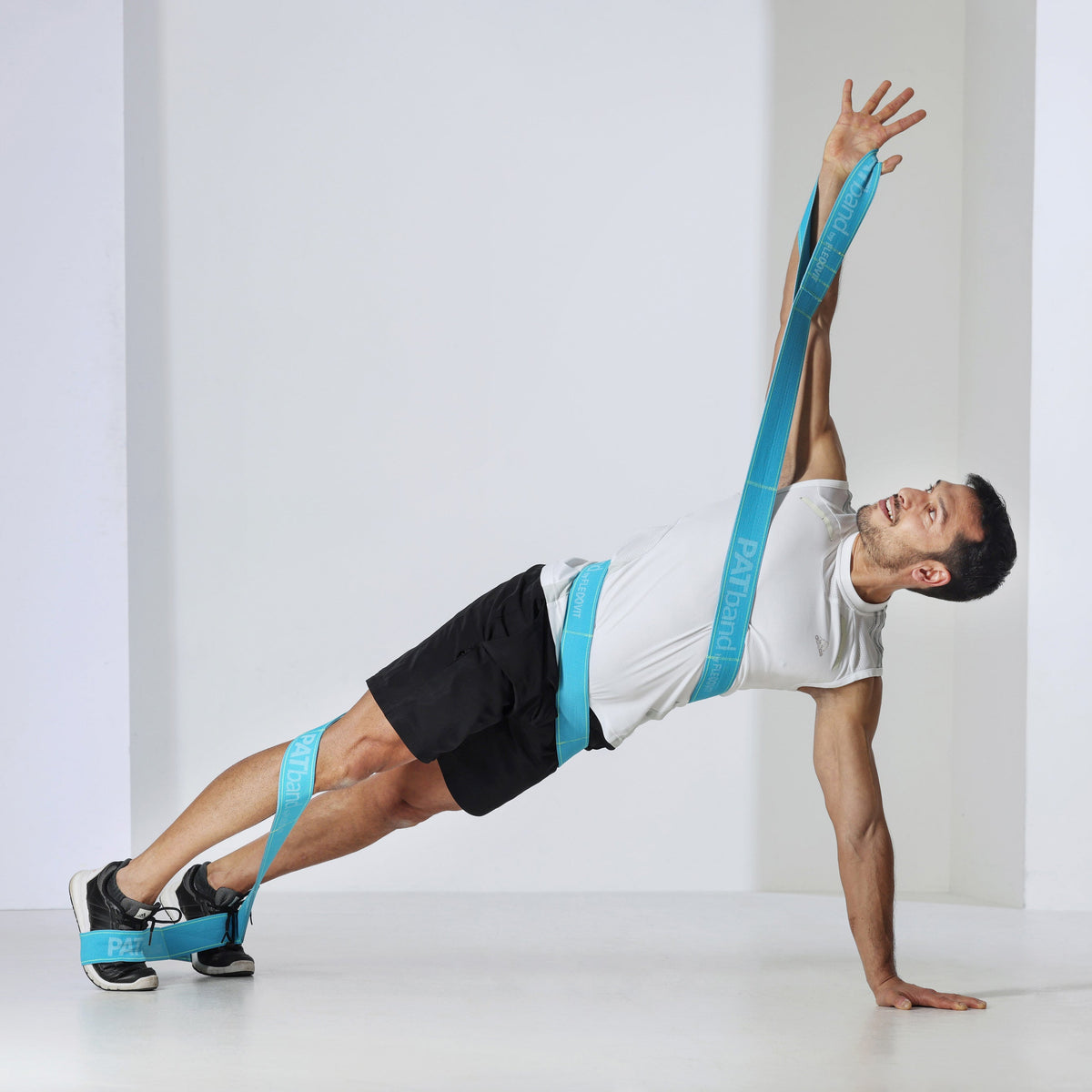
- forearm plank,
- side plank,
- plank with leg movement,
- bear plank,
- or plank variations with FLEXVIT Mini or FLEXVIT Multi.
- guide movement,
- challenge stability,
- create rotation,
- train anti-rotation,
- or support a movement.
- shoulder exercises,
- technique preparation,
- activation,
- unilateral training,
- and gradual progression.
- before water training,
- in the athletic room,
- at the poolside,
- in training camp,
- or at home.
- hip activation,
- leg axis control,
- shoulder activation,
- plank variations,
- and short warm-up routines.
- rowing movements,
- push exercises,
- rotation and anti-rotation,
- full-body exercises,
- mobilization,
- partner training,
- as well as swimming-specific movement patterns.
- strength-oriented exercises,
- assisted movements,
- squats and hip hinges,
- pull and push variations,
- as well as exercises on a fixed anchor point.
- jump and start training,
- acceleration movements,
- partner exercises,
- powerful hip extension,
- and dynamic full-body tasks.
- Thoracic spine rotation: 6 to 8 repetitions per side
- Shoulder movement with the FLEXVIT Chain: 8 to 12 repetitions
- Hip mobilization: 6 to 8 repetitions per side
- Scapular push-up: 8 to 12 repetitions
- Lateral steps with the FLEXVIT Mini: 2 × 8 to 12 steps per direction
- External rotation with light band: 2 × 10 to 15 repetitions
- Anti-rotation with the FLEXVIT Multi: 2 × 8 to 10 repetitions per side
- Squat Jumps: 3 × 3 to 5 repetitions
- Horizontal jumps: 3 × 3 repetitions
- Explosive hip extension against partner resistance: 3 × 5 repetitions
- Stable landing with short hold phase
- Age,
- training level,
- swimming discipline,
- competition phase,
- water volume,
- recovery ability,
- and individual resilience.
- reduced range of motion,
- shrugged shoulders,
- compensatory movements of the torso,
- and lack of control.
Why strength training is beneficial for swimmers
Water simultaneously provides resistance and a working surface for your body. You need to move the water backward as effectively as possible to propel your body forward. Unlike a sprint or a jump, however, you cannot continuously push off a solid surface. Apart from starts and turns, your forces act against a moving medium. This places special demands on your coordination:
You must build pressure without losing control of your body position. You need sufficient strength, but you must not apply it haphazardly. And you must execute every movement with as little additional resistance as possible.
Scientific reviews show that the combination of swimming and strength training can be more effective than exclusive training in the water. At the same time, there is no definitive answer as to which single strength training method works best for every swimmer. General strength training, swim-specific dryland training, and specific resistance training can all be useful, provided they are appropriately planned and coordinated with water training. (PMC)
The crucial question, therefore, is not:
Which training most closely resembles swimming?
But:
What physical ability is currently limiting your performance in the water – and how can you specifically improve it on land?

What your body has to achieve when swimming
From a biomechanical perspective, swimming is far more than a sequence of arm strokes and leg kicks. Several tasks must be solved simultaneously.
Generating propulsion
In freestyle, backstroke, breaststroke, and butterfly swimming, propulsion is generated by the coordinated interplay of arms, legs, and torso.
How much individual body parts are involved depends on the stroke, distance, and technique. Basically, your limbs must generate sufficient force against the water and transfer it in the desired direction of movement.
Especially in sprint swimming, strength and mechanical power play an important role. Correlations between upper body pulling force and swimming performance can be observed, among other things. (PMC)
Limiting water resistance
More strength does not automatically lead to more speed.
If you lose your body line, your legs sink, or you deviate strongly to the side with each arm stroke, the surface area you move against the water increases. A portion of your strength is then invested not in propulsion, but in unnecessary movements and additional resistance.
A stable body position in the water is therefore not a purely technical skill. It also depends on whether you can control your torso and hips over the entire distance.
Transferring forces through the body
A powerful arm stroke helps you only to a limited extent if your torso cannot withstand the resulting torque.
In front crawl and backstroke, the body rotates around its longitudinal axis. This rotation should support the movement, not destabilize it. Your torso must therefore simultaneously allow movement and control unwanted evasive movements.
The same principle applies to breaststroke and butterfly: force is not generated in isolation by a single muscle. It runs through interconnected kinetic chains throughout the entire body.
Controlling repetitive overhead movements
Swimmers perform a very large number of cyclical arm movements during training. The shoulder joint must be mobile enough to achieve the desired position and, at the same time, stable enough to control the humeral head during exertion.
This combination of great mobility and repeated force transmission makes the shoulder a particularly demanding area.
Good strength training for swimmers must therefore not only strengthen the large propulsive muscles. It must also consider the movement quality of the scapula, the rotator cuff, and core control.
Generating explosive forces for starts and turns
Starts and turns differ significantly biomechanically from free swimming.
Here, the swimmer can push off a solid surface with their feet. This requires a rapid extension of the ankle, knee, and hip, as well as the ability to then bring the body into a stable and hydrodynamic position.
Systematic studies suggest that strength, ballistic, and jump training can improve the prerequisites for an efficient turn. In particular, the neuromuscular capabilities of the leg extensors play an important role. (PMC)

Which muscles are particularly important for swimming?
The question of the "most important swimming muscles" is understandable. However, it falls short.
Swimming is not a series of isolated muscle actions. What matters is how well different muscle groups work together within a kinetic chain.
Shoulder girdle and upper back
The latissimus dorsi muscle contributes significantly to powerful pulling movements. Pectoral muscles, shoulder muscles, and arm flexors also support the movement, depending on the stroke and pulling phase.
At the same time, the muscles around the scapula must control its position and movement. These include:
The scapula must not be rigidly "fixed back and down." It must be able to move on the rib cage in conjunction with arm movement. During arm elevation, controlled upward rotation and an adjustment of the scapular position are necessary, among other things.
In functional training, therefore, it is not about permanently holding a supposedly perfect position, but about movement control.
Pectoral and latissimus musculature
The pectoralis major and latissimus dorsi are important force producers. However, due to the high volume of pulling and internal rotation movements, they can also contribute to a dominant anterior or inwardly directed load.
This does not mean that these muscles are fundamentally "shortened" or problematic. Rather, it means that strength training for swimmers should not consist exclusively of further pulling movements.
Mobility, external rotation, controlled pushing movements, and active scapular movement also belong in a balanced program.
Core musculature
The core does not simply hold your body "stiff."
It must:
For swimmers, therefore, not only classic abdominal exercises are relevant. Particularly important are exercises where you resist movement or transfer force between different body regions.
These include:
Hips, glutes, and legs
Leg muscles do more than just support the leg kick.
Strong hip and leg extensors are particularly relevant for starts, turns, and push-offs. At the same time, pelvic control influences your body position in the water. If the hips sink or the body goes into strong hyperextension, water resistance often increases.
Dryland training for swimmers therefore also includes:
Those who only consider shoulders and back in strength training do not train the swimmer as a complete athlete.

Why swimming alone doesn't develop all abilities
Swimming primarily improves the abilities you regularly need in the water. This is the principle of specificity – and generally sensible.
Nevertheless, exclusive swimming training can leave certain gaps.
External load is harder to control
In water, resistance changes due to factors like speed, technique, body position, and aids used.
In dryland training, you can dose the load more precisely and work on individual abilities more in isolation. For example, you can:
Some directions of movement are neglected
Swimmers perform many movements in swim-specific patterns. Other fundamental movements occur much less frequently or with only low intensity.
Depending on the training program, these may include:
Dryland training expands your movement repertoire and can thus help maintain your general athletic base.
Strength on land does not automatically transfer to water
A higher weight in bench press does not immediately make you a faster swimmer.
Strength must be applied in a coordinated and technically sound manner in a swim-specific situation. Research shows that the transfer between dryland training and swimming performance depends on several factors. These include training method, movement speed, technical quality, training volume, and performance level. (PMC)
This means:
Strength training does not replace swimming training. It improves the physical prerequisites upon which good swimming can be built.
Dryland training for swimmers: Mimic or supplement?
Many classic dryland exercises try to imitate the swimming stroke as accurately as possible on land.
Such exercises can be useful, for example, to:
However, the movement remains an approximation.
On land, buoyancy and water resistance are absent. The direction and distribution of forces differ. The duration of the pulling phase is also often not identical to the actual movement in the water. A systematic review indicates that even swim-like exercises on land are not fully swim-specific. (PMC)
Therefore, your athletic training should consist of three levels.
1. General functional strength training
Here you develop fundamental abilities such as:
2. Swim-specific supportive training
Here you train qualities with a clear connection to swimming, for example:
3. Technique-related dryland exercises
Here you consciously work on positions and movement sequences that you then want to apply in the water.
These three levels complement each other. None of them alone should determine the entire dryland training.
The DAILY 7 Exercises as a basis for swimmers

The FLEXVIT DAILY 7 exercise concept is based on seven fundamental movement patterns:
Instead of exclusively training individual muscles, you structure your training with complete movements. (FLEXVIT - Bands Reloaded)
For swimmers, this offers a clear advantage: the DAILY 7 help you to train the body as a whole, not just to repeat the visible swimming movements.
Squat – Squat
The squat develops strength in the legs and hips and prepares you for powerful extension movements.
For swimmers, this is particularly relevant for:
With a FLEXVIT Mini above the knees, you can additionally create lateral resistance and train leg axis control.
Lunge – Lunge
Lunges challenge the legs unilaterally and combine strength with balance.
Although swimming appears predominantly symmetrical, differences often arise between body sides. Breathing side, flexibility, daily life, and previous complaints can contribute to this.
Lunge variations help you to specifically load each side and to become more aware of differences.
Hinge – Hip Hinge
In the hinge, you move primarily from the hips while the torso remains controlled.
This movement pattern particularly strengthens:
This strength base supports explosive push-offs and helps you control a stable pelvic position.
Push – Push
Swimmers often think of pulling movements first when it comes to strength training. However, a balanced program also requires controlled pushing.
Push exercises not only train the chest, shoulders, and arms. When performed well, they can also promote active movement and stabilization of the scapula.
Suitable variations include, for example:
Pull – Pull
Pull movements have an obvious connection to swimming.
With rowing exercises and diagonal pulls, you train:
Crucially, though, execution is key. Do not forcefully pull your shoulders to your ears with every repetition. Keep your neck long and perform the movement using controlled scapular and arm movements.
Twist – Rotation
Rotation is a central component of technique, especially in front crawl and backstroke.
However, on land, you shouldn't just train active rotation. Equally important is the ability to resist unwanted rotation.
With a FLEXVIT Multi fixed at the side, you can, for example:
Plank – Support
Support exercises train the ability to stabilize the torso against external forces.
For swimmers, variations where the body line is maintained despite arm or leg movement are particularly interesting.
Examples:
A good plank position does not mean being maximally tense and immobile. The goal is a stable starting position from which you can continue to work in a controlled manner.
You can learn more about the seven basic movement patterns in the FLEXVIT DAILY 7 Training Concept.

Why resistance bands are particularly suitable for swimmers
Resistance bands are not automatically better than dumbbells, cable machines, or other training tools. However, they have properties that make them particularly practical for dryland training in swimming.
Resistance in many directions
A band can pull sideways, diagonally, from above, or from below.
This allows you not only to strengthen muscles but also to:
This versatility is particularly valuable for the shoulder complex and the torso.
Increasing resistance
The further an elastic band is stretched, the greater its resistance usually becomes.
This can be useful for various exercises. For a rowing movement, for example, the tension is higher in the end position than at the beginning. This allows the active end position to be specifically loaded.
However, the actual load depends on the band strength, initial length, stretch, and pull angle. Therefore, the strongest band level is not automatically the best choice.
Finely adjustable exercises
You can adjust the resistance using different band strengths, loops, and distances.
This is particularly helpful for:
Usable directly at the poolside
FLEXVIT bands require little space and are easy to transport.
This means you can use them:
This facilitates regular integration into daily training.
Which FLEXVIT bands are suitable for swimmers?
Depending on the training goal, the individual band types fulfill different tasks.
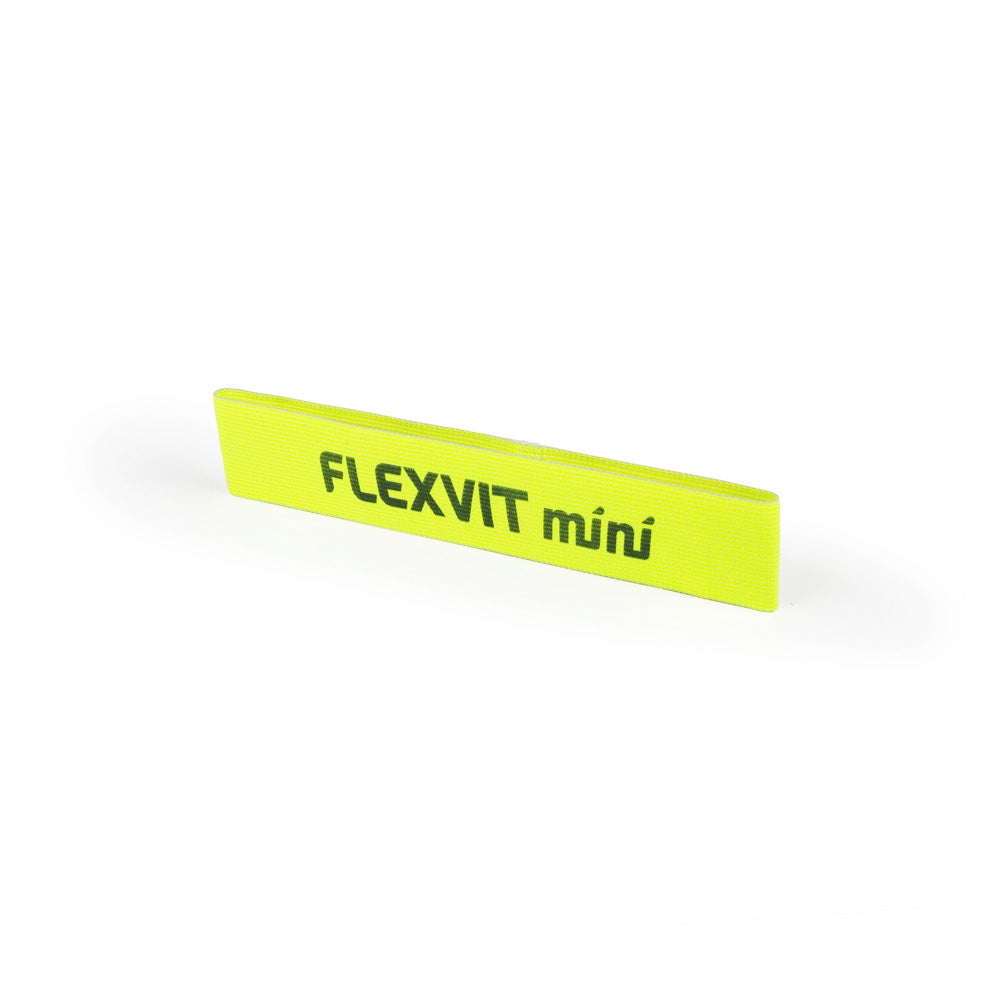
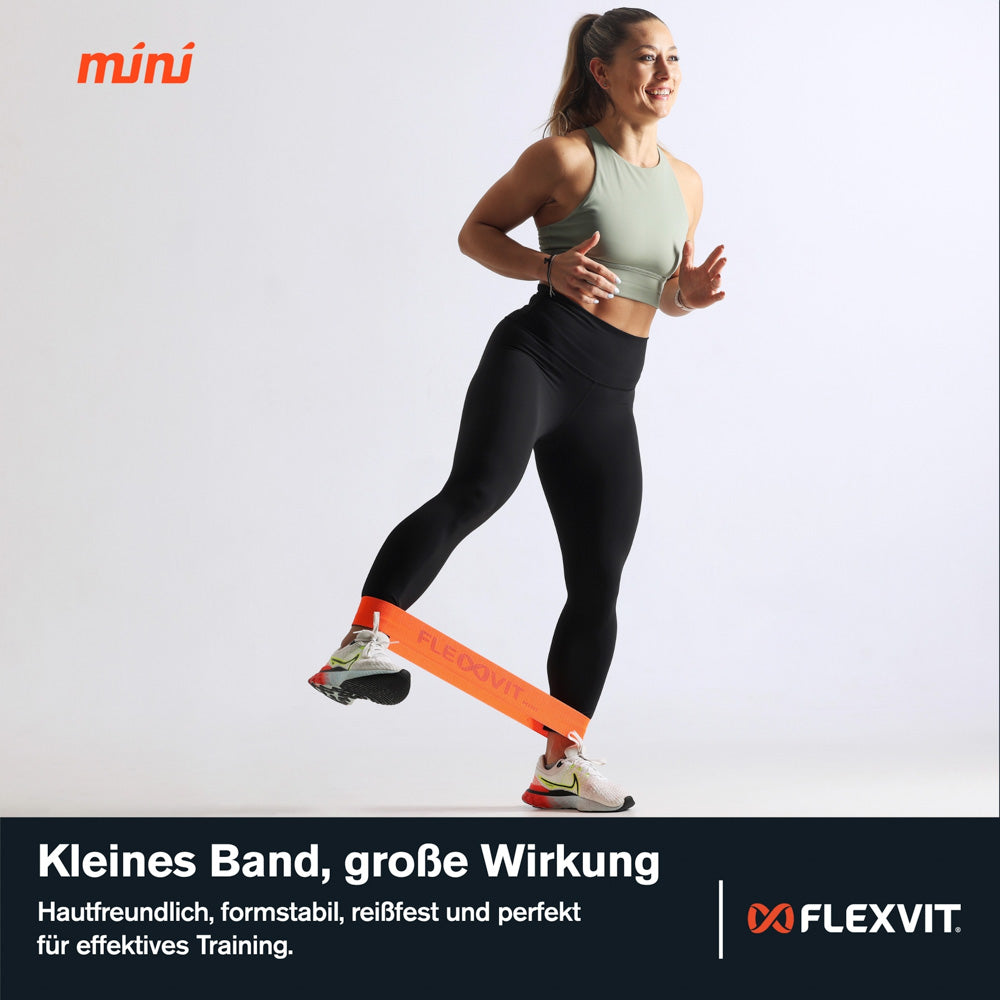
FLEXVIT Mini
The FLEXVIT Mini is a compact mini-band.
It is suitable, for example, for:
Especially before water training, you can use it to set targeted stimuli without already performing fatiguing strength training.
FLEXVIT Multi
The FLEXVIT Multi has several loops, allowing for numerous grip, entry, and attachment variations.
It is suitable, among other things, for:
Thanks to the loops, you can quickly change the effective length and your position relative to the resistance.
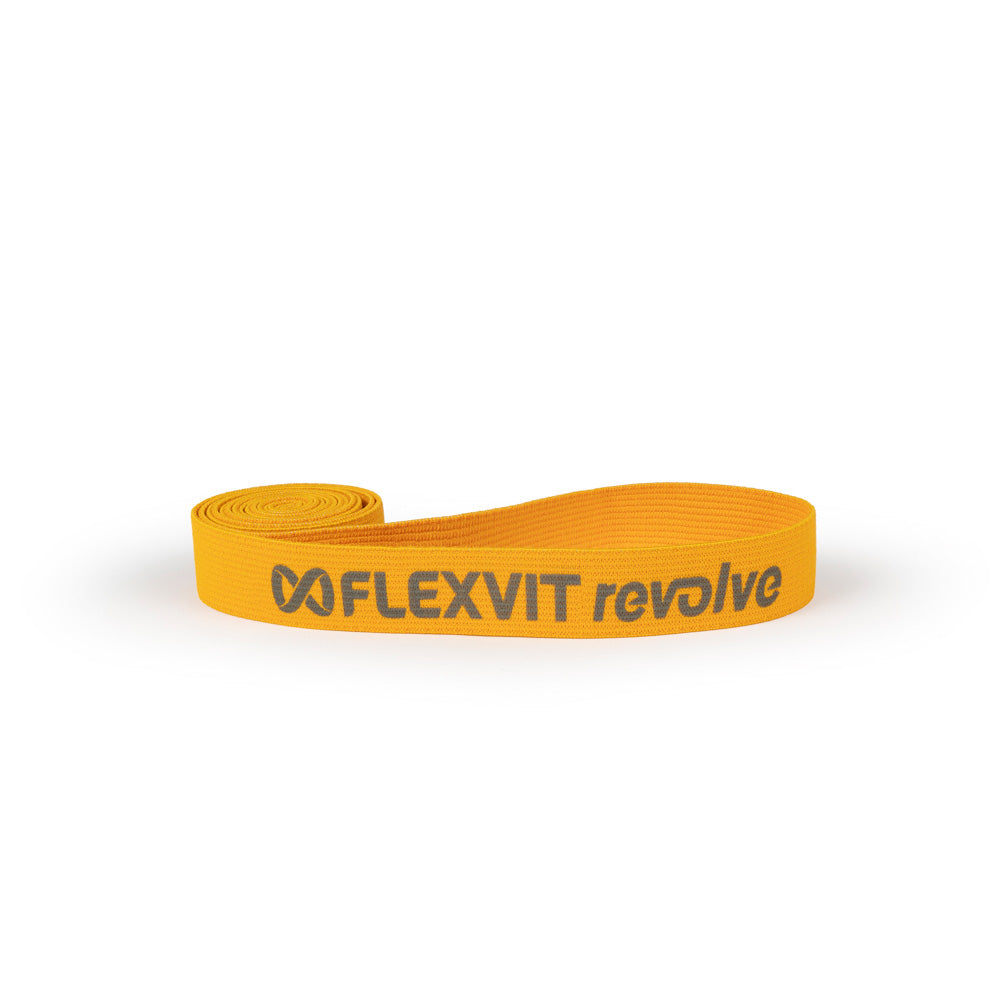
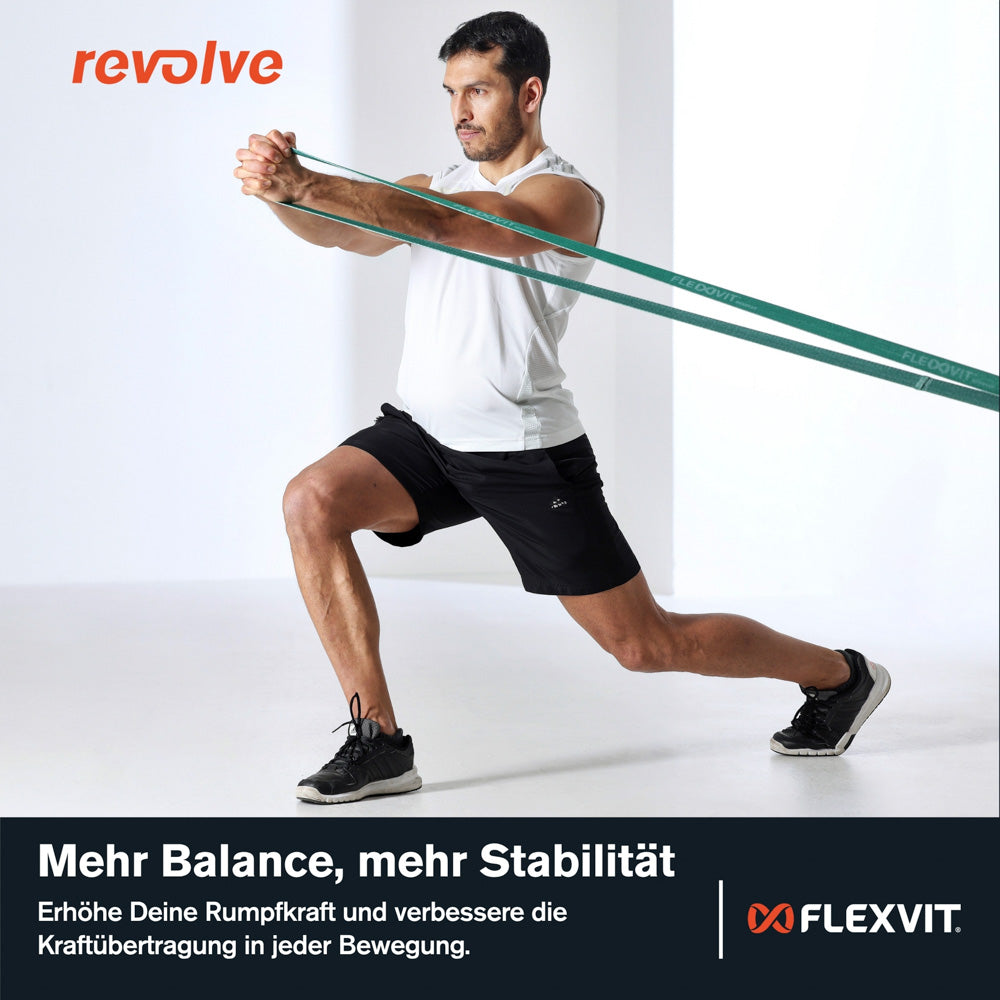
FLEXVIT Revolve
The FLEXVIT Revolve is a closed superband.
It can be used for:
Different resistance levels allow the band to be used for various performance levels.
FLEXVIT Chain
The FLEXVIT Chain is particularly suitable for fluid movement sequences, mobility, and muscle-length training.
For swimmers, it can help to move the chest and shoulder area, the spine, and interconnected movement chains in a controlled manner.
The goal is not to passively force joints into a maximal range of motion. Mobility training should make a position available and actively controllable.
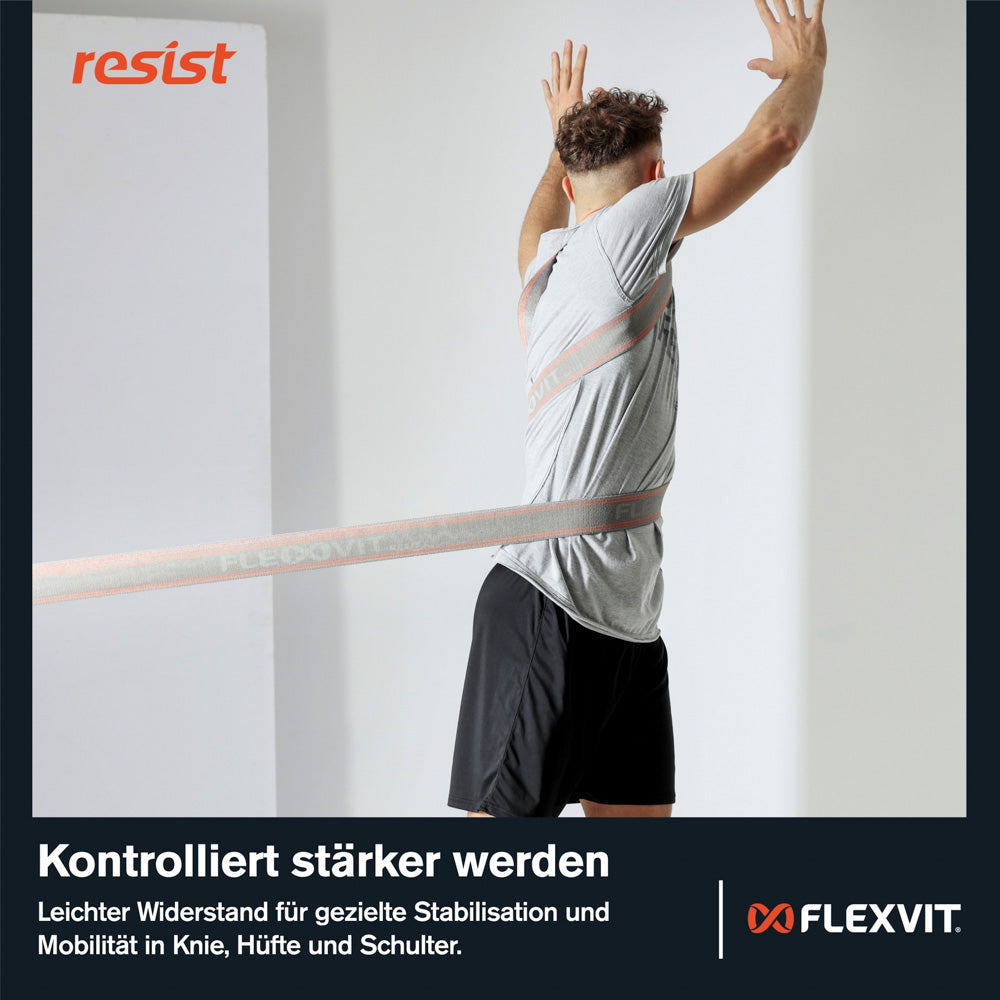
FLEXVIT Resist
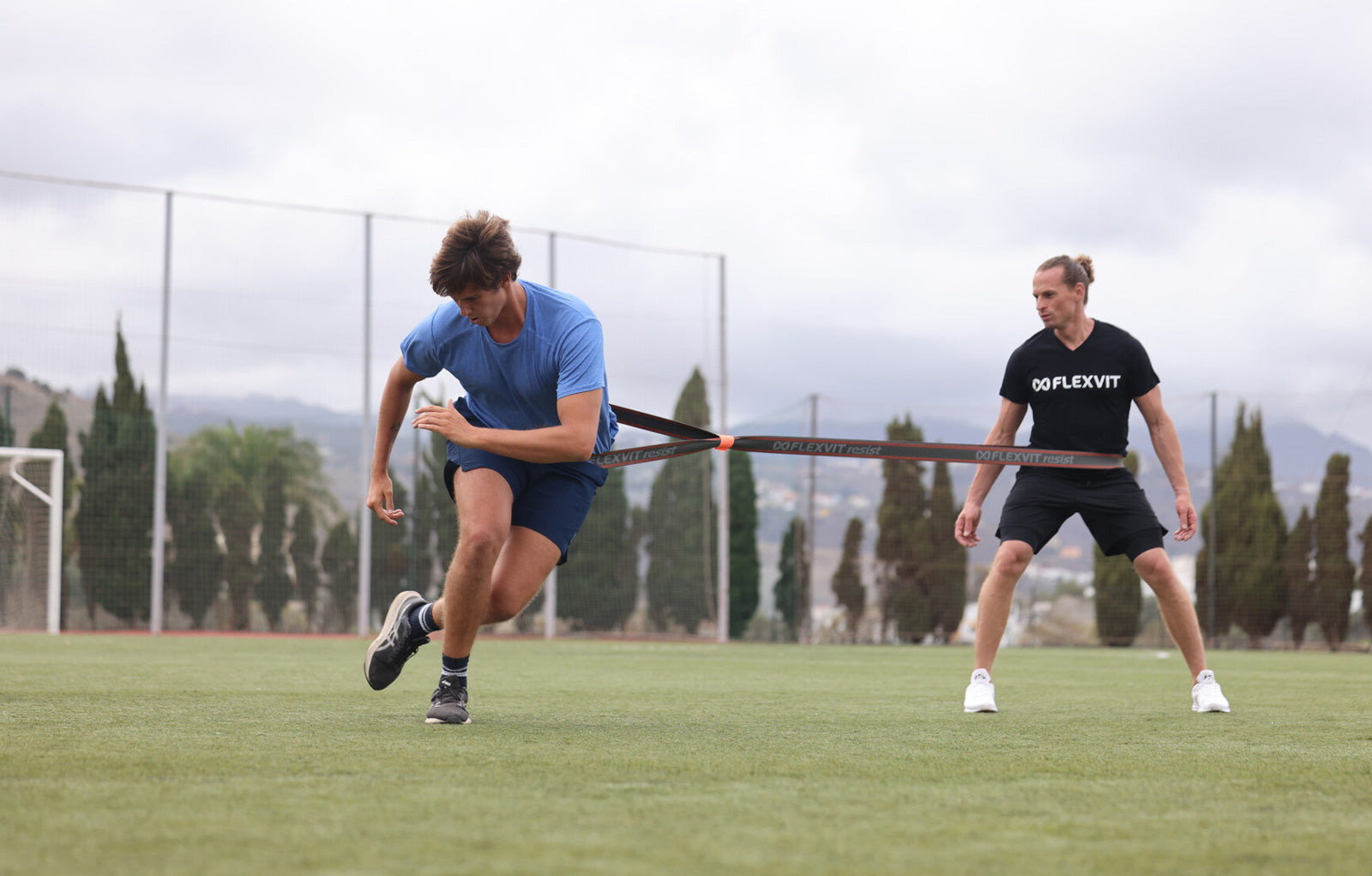
The FLEXVIT Resist can create a stronger external pull on the body.
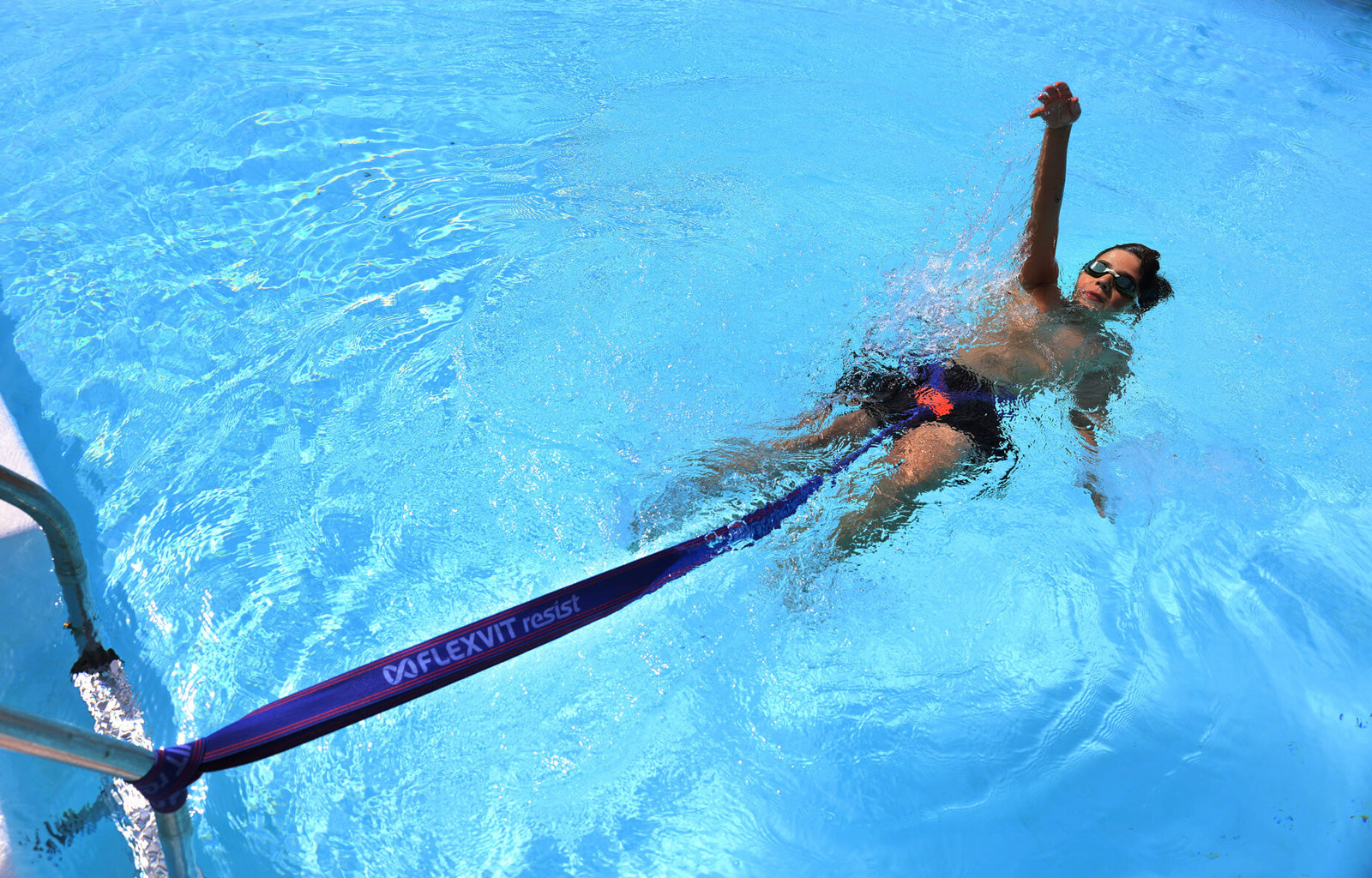
For swimmers, it is particularly interesting for:
It is less suitable for fine, isolated shoulder exercises, but all the more for athletic movements where the entire body works against a directed resistance.

Example: Functional strength training for swimmers
The following unit is intended as a general example. Volume and intensity should be adjusted to training age, performance level, water training, and individual conditions.
1. Preparation and mobility
Perform each exercise in a controlled manner.
The goal is not maximal stretching, but good awareness and active control of the available ranges of motion.
2. Activation
Choose a moderate resistance. The exercises should prepare you and not completely fatigue you yet.
3. Strength part
Squat
Squat with FLEXVIT Revolve or FLEXVIT Mini
3 sets of 6 to 12 controlled repetitions.
Hinge
Hip hinge or Romanian Deadlift with FLEXVIT Revolve
3 sets of 8 to 12 repetitions.
Push
Standing chest press with the FLEXVIT Multi
3 sets of 8 to 12 repetitions.
Pull
Rowing with the FLEXVIT Multi or FLEXVIT Revolve
3 sets of 8 to 15 repetitions.
Twist
Anti-rotation or controlled diagonal rotation with the FLEXVIT Multi
2 to 3 sets of 8 to 12 repetitions per side.
Plank
Side plank or plank with controlled arm movement
2 to 3 sets of 20 to 40 seconds per side.
4. Optional start and turn block
This part is intended for resilient and appropriately prepared swimmers.
For explosive exercises, quality takes precedence over fatigue. End the set as soon as jump height, speed, or landing control visibly decrease.
How often should swimmers do strength training?
The ideal frequency depends on several factors:
For many swimmers, two structured strength sessions per week are a sensible starting point. Shorter activation and mobility routines can be used more frequently.
Coordination with water training is crucial. An intense strength block immediately before a technically demanding or fast swimming session can impair movement quality.
Strength training should complement swimming training, not uncontrollably create additional fatigue.
Common mistakes in strength training for swimmers
Only mimicking the swim stroke
The more a exercise resembles swimming, the greater its benefit is not automatically.
Swim-specific dryland exercises can improve perception. However, they do not replace fundamental strength work for the legs, hips, core, and shoulder girdle.
Only pulling
Swimmers already complete an enormous volume of pulling movements.
Additional pull exercises can be useful but should be supplemented by push, external rotation, core training, leg training, and mobility.
Permanently fixing the shoulder blade
The cue "shoulders back and down" can help prevent excessive shrugging in individual exercises.
However, during natural overhead movements, the shoulder blade must be allowed to move. A rigid fixation can hinder arm elevation rather than improve it.
Therefore, don't just train one position, but the ability to control the shoulder blade in different situations.
Using too much resistance
Especially in shoulder exercises, a too strong band often leads to:
Reduce the resistance as soon as you can no longer perform the target movement cleanly.
Neglecting legs and hips
Starts, turns, body line, and kick all benefit from a powerful lower body.
Training that consists only of shoulder and back exercises does not fully represent the demands of swimming.
Trying to train through pain
Pain is not proof of effective training.
In case of acute or persistent shoulder complaints, the cause should be professionally clarified. A general training plan cannot replace individual diagnostics or therapy.
Frequently asked questions about strength training for swimmers
What strength training is useful for swimmers?
A combination of general functional strength training, swim-specific supportive exercises, and selected technique-related dryland exercises is useful. The entire body, the seven basic movement patterns, and individual weaknesses should be trained.
Can strength training improve swimming performance?
Yes, strength training can develop the physical prerequisites for better swimming performance. Studies show benefits of combining swimming and strength training. However, the transfer depends on training method, dosage, technique, and coordination with water training. (PMC)
Which muscles should swimmers train particularly?
The shoulder girdle, upper back, rotator cuff, core, hips, and legs are important, among others. Instead of only considering muscles in isolation, training should be geared towards complete movements and coordinated power transfer.
Are resistance bands suitable for swimmers?
Yes. Resistance bands allow for different pulling directions, finely adjustable resistances, and functional exercises for the entire body. They are suitable for warm-up, strength training, mobility, and swim-specific supportive exercises.
How often should swimmers train on land?
For many swimmers, two strength training sessions per week are a sensible starting point. However, frequency and volume must match water training, performance level, and competition phase.
Does dryland training have to imitate the swim stroke?
No. Swim-specific movements can be a component but do not constitute the entire athletic training. Fundamental strength, core control, leg power, and shoulder health are often trained more effectively through complementary movement patterns.
Which exercises improve body position in the water?
Exercises for anti-extension, anti-rotation, lateral core stability, and pelvic position can improve the physical prerequisites for a stable body position in the water. The implementation in the water must then be developed in swimming training.
Is strength training also suitable for junior swimmers?
Age-appropriate and professionally supervised strength training can also be useful for junior swimmers. The focus is initially on movement competence, technique, controllable resistances, and gradual progression.
Conclusion: Swimmers need more than strong arms
High pulling power is important. However, it alone does not make a high-performing swimmer.
For your strength to be effective in the water, your shoulder girdle, core, hips, and legs must work as a cohesive system. You need mobility without losing control. You need stability without stiffening your body. And you need strength that you can technically translate into propulsion.
Functional strength training provides the foundation for this.
The DAILY 7 Exercises – Squat, Lunge, Hinge, Push, Pull, Twist, and Plank – help you structure your dryland training completely and comprehensibly. FLEXVIT bands allow you to apply resistance from different directions, specifically support movements, and individually adjust loads.
This way, you don't just train individual swimming muscles.
You develop a body that can absorb, control, and efficiently transfer forces into the water.
Movement is life. Are you ready?