
Hardly any joint is subjected to such frequent and extensive ranges of motion during swimming as the shoulder. With every lap, the arm stroke, recovery phase, and overhead position are repeated many times. Over a complete training session, hundreds or even thousands of movement cycles quickly accumulate.
These repetitions are necessary for swimming-specific performance. At the same time, they demand a lot from the shoulder complex: The shoulder joint must be mobile, the humeral head must be guided in a controlled manner, and the shoulder blade must move on the rib cage in sync with the arm movement.
This is precisely why it is not enough to only strengthen the latissimus, chest, or arms during shoulder training for swimmers. The coordinated interplay of:
- scapular movement,
- rotator cuff,
- thoracic spine,
- core control,
- mobility,
- strength,
- and sensibly managed training load
is crucial.
Functional compensatory training with resistance bands can help you train these abilities specifically on land. The bands do not replace proper swimming technique or a medical examination for existing complaints. However, they allow you to finely dose resistance, use different directions of pull, and consciously perceive movements.
In this article, you will learn how "swimmer's shoulder" develops, which muscles are important for shoulder training, and how to use FLEXVIT bands effectively for prevention, warm-up, and functional compensatory training.
What does "swimmer's shoulder" mean?
The term swimmer's shoulder does not refer to a single, clearly defined injury. It is used as a collective term for complaints that occur in the shoulder area in swimmers.
Depending on the athlete, different structures and causes can be involved. These include, among others:
- irritated rotator cuff tendons,
- reduced load capacity of the shoulder,
- insufficient scapular control,
- changes in mobility,
- high or too rapidly increased training volumes,
- technical compensatory movements,
- as well as an imbalance between current load and individual load capacity.
Shoulder pain during swimming is therefore rarely caused by a single "shortened muscle". Usually, several factors come together.
This also makes it clear why a general exercise program does not replace individual diagnostics. Persistent, increasing, or everyday pain should be examined by a doctor or physiotherapist.

Why the shoulder is particularly challenged during swimming
The shoulder joint allows for a very large range of motion. This mobility is indispensable for the different swimming styles.
However, it comes at a price: In contrast to joints with stronger bony guidance, the shoulder is highly dependent on active control by muscles and the nervous system.
During the swimming stroke, several tasks must be solved simultaneously.
The arm must be brought into the correct position
In crawl and backstroke, the arm is repeatedly moved overhead. In butterfly and breaststroke, large movements also occur in the shoulder girdle.
Not only does the upper arm move in the shoulder joint. The shoulder blade must move along with it on the rib cage so that the arm can achieve the necessary range of motion.
The humeral head must be controlled
The rotator cuff consists of four muscles:
- M. supraspinatus,
- M. infraspinatus,
- M. teres minor,
- M. subscapularis.
Together, they help to guide and center the humeral head in the joint during movement.
For external rotation, the M. infraspinatus and M. teres minor are particularly relevant. The M. supraspinatus primarily supports arm elevation and joint centering. Therefore, it should not be simply referred to as the primary external rotator.
The shoulder blade must transmit force
The shoulder blade forms the mobile base of the shoulder joint. If this base loses its control, the arm can also transmit its force less effectively.
When swimming, depending on the phase of movement, the shoulder blade must, among other things:
- glide forward and backward,
- rotate upward,
- adapt to the rib cage,
- and tilt forward or backward.
Therefore, there is no single shoulder blade position that should be maintained throughout the entire swimming stroke.
Healthy shoulder function does not mean permanently "pinching the shoulder blade down and back." It means that it can move in a controlled manner and appropriately for the respective arm movement.
The typical direction of stress in swimming
Many propulsive movements in swimming involve elements of:
- shoulder adduction,
- internal rotation,
- arm extension,
- as well as strong pull against the water.
Among others, the latissimus, pectoralis major, teres major, and various arm muscles are involved.
These muscles are important for performance. They are not inherently problematic and should not simply be "switched off."
However, due to the high swimming-specific volume, a training profile can emerge in which other functions are relatively neglected. These include, for example:
- controlled external rotation,
- horizontal pushing,
- active upward rotation of the shoulder blade,
- stability against unwanted movement,
- as well as strength in less frequently used arm positions.
Good compensatory training therefore complements swimming training. It does not try to weaken the performance-relevant muscles but expands the available movement and strength options.

Which muscles should swimmers consider when training their shoulders?
Shoulder health does not come from a single target muscle. It is the result of coordinated movement.
Functional shoulder training for swimmers should particularly consider the following areas.
External rotators of the shoulder
The M. infraspinatus and M. teres minor externally rotate the upper arm and support the guidance of the humeral head.
In swimming, they are opposed by many pulling and internal rotation movements. Targeted strengthening of external rotation can therefore be a meaningful component of compensatory training.
The goal is not to handle the strongest possible band resistance. External rotation exercises quickly lose their effectiveness if you:
- move your elbow away from your body,
- shrug your shoulder,
- rotate your upper body,
- flex your wrist,
- or achieve the range of motion only through momentum.
A light, controllable resistance is often the better choice.
Middle and lower trapezius muscle
The middle part of the trapezius muscle supports, among other things, the retraction of the shoulder blade. The lower part is involved in the control, upward rotation, and stabilization of the shoulder blade.
Both areas are relevant for swimmers. However, they should not be trained in isolation with the goal of maximally pulling the shoulder blade back and down with every movement.
In rowing and compensatory exercises, controlled retraction can be useful. In overhead movement, however, the shoulder blade must be able to rotate upward.
Serratus anterior
The serratus anterior muscle is often underestimated in shoulder training.
It helps to guide the shoulder blade on the rib cage, supports its upward rotation, and is important for controlled pushing and overhead movements.
Exercises such as scapular push-ups, controlled pressing movements, or wall slide variations can help to train this function.
Rhomboid muscles
The rhomboid muscles support, among other things, the retraction and control of the shoulder blades.
They are involved in rowing movements but should not be considered the sole solution against a forward-oriented shoulder posture. Here, too, the interplay with the trapezius muscle, serratus anterior, rotator cuff, and rib cage is crucial.

Core musculature
An apparent shoulder exercise quickly becomes a compensatory movement of the entire body if the core cannot control the resistance.
In external rotations, rowing exercises, and diagonal pulls, you should therefore ensure that:
- the pelvis remains stable,
- the rib cage does not compensate uncontrollably,
- the spine is not hyperextended,
- and the movement actually originates from the shoulder and shoulder blade.
Shoulder training for swimmers is therefore always also training for body control.
Why "shoulders away from ears" can help - but is not a universal rule
In many band exercises, swimmers unconsciously shrug their shoulders. Especially with too much resistance, a visible shoulder shrugging movement often takes over.
The cue
"Keep your neck long and create distance between your shoulder and ear"
can be helpful in such situations.
It helps you to recognize excessive shrugging and to perform the movement more controllably.
The instruction becomes problematic if it leads to a permanent and maximal pulling down of the shoulder blades. In a natural arm elevation, the activity of the upper trapezius muscle is not inherently undesirable. Together with the lower trapezius muscle and the serratus anterior, it supports the necessary upward rotation of the shoulder blade.
Therefore, the training goal is not:
Completely switch off the upper trapezius muscle.
But:
Avoid a dominant shoulder shrugging movement and improve the coordinated interaction of the entire shoulder girdle.
Does compensatory training have to take place below 90 degrees?
Exercises below shoulder height can be very useful for beginners.
This is especially true if you:
- shrug your shoulder during overhead movements,
- cannot yet control a position,
- are returning to training after a break,
- or want to start in a pain-free, easily controllable range.
External rotations close to the body, low rowing movements, and various retraction exercises can be trained very well in this area.
However, this does not imply a universal rule that exercises above 90 degrees are fundamentally bad or that the upper trapezius muscle would automatically be harmfully active.
Swimmers must master overhead positions. Once basic control is established, movements above shoulder height should therefore also be trained gradually and adapted to individual load capacity.
For practical application, a progression is suggested:
- controlled exercises below shoulder height,
- increasing range of motion,
- diagonal movements,
- controlled overhead positions,
- more dynamic and swim-specific loads.
The angle alone does not determine the quality of an exercise. Control, pain-free movement, dosage, and the individual training phase are decisive.
Mónica Solana: Shoulder work from professional swimming
Important impulses for the following training content come from Dr. Mònica Solana-Tramunt.
She is a physiotherapist specializing in sports physiotherapy and osteopathic manual therapy, a sports scientist, and holds a doctorate in sports science. In a published speaker profile, she is also presented as a university lecturer and head physiotherapist for the Spanish Swimming Federation and its Olympic teams.
In her practical work, she deals intensively with the physical demands of swimming and also uses FLEXVIT bands to prepare movements in a controlled manner and to set targeted muscular stimuli.
You can find more insights into her work on her Instagram profile:
Dr. Mónica Solana on Instagram
Her exercises highlight an important fundamental idea: Compensatory training is not about pulling a band as far apart as possible. What matters is what movement actually occurs in the shoulder girdle and whether the athlete can consciously control it.
Video 1: Scapular control and external rotation with FLEXVIT
In the first video, Mónica Solana demonstrates exercises for the muscles around the shoulder blade and shoulder joint.
This video is particularly suitable as a practical addition to the following basic principles:
- light to moderate resistance,
- controlled range of motion,
- long neck,
- no jerky pulling movements,
- conscious guidance of the shoulder blades,
- even movement of both sides.
Don't just observe how far the band moves. Pay attention to whether one shoulder shrugs earlier, one shoulder blade moves back faster, or the upper body deviates to the stronger side.
Video 2: Functional compensatory training for the shoulder girdle
The second video expands the shoulder work with additional positions and directions of movement.
Do not use the video as an invitation to immediately imitate every exercise with maximum resistance. Choose the band strength so that you can consciously control the movement.
Especially with small shoulder exercises:
The visible movement can be small, while the coordinative demand is very high.
Six Exercises for Healthy and Resilient Swimmer's Shoulders
The following exercises can be used as a warm-up, supplementary shoulder workout, or a short compensatory routine.
They are intended for swimmers without pain. In case of pain, loss of strength, or significant movement restrictions, an individual examination should first be carried out.
1. External Rotation at the Body
This exercise primarily strengthens the infraspinatus and teres minor muscles.
Suitable Band
- light FLEXVIT Mini,
- light FLEXVIT Revolve,
- or appropriately anchored FLEXVIT Multi.
Starting Position
Stand upright. Your elbow is bent at approximately 90 degrees and tucked at your side.
Keep your neck long and your wrist neutral. A small towel between your elbow and torso can help you maintain the position.
Execution
Rotate your forearm outwards in a controlled manner, without letting your elbow leave your body.
Stop the movement before:
- your upper body rotates with it,
- your shoulder moves upwards,
- or your wrist deviates.
Slowly return your arm to the starting position.
Dosage
- 2 to 3 sets,
- 10 to 15 repetitions per side,
- controlled tempo.
Common Mistakes
- band is too strong,
- rotation of the entire upper body,
- elbow loses contact with the body,
- shoulder is forced backward,
- fast return movement without control.
2. Symmetrical External Rotation with Open Band Pull
This variation allows you to compare both sides simultaneously.
Suitable Band
- FLEXVIT Mini,
- FLEXVIT Multi,
- or light FLEXVIT Revolve.
Starting Position
Hold the band with both hands in front of your body. Your elbows remain bent and tucked at your sides.
Your palms can face upwards or towards each other, depending on the band and grip position.
Execution
Move both hands apart in a controlled manner.
Your elbows remain still. Do not actively pull your shoulders back to their maximum. Allow the movement to originate from external rotation and a slight, controlled scapular movement.
Slowly return to the starting position.
Focus on Perception
Pay attention to:
- Do both arms start simultaneously?
- Does one hand move further?
- Does one shoulder pull up faster?
- Does your upper body rotate to one side?
You can perform individual repetitions with your eyes closed, provided you are stable and master the exercise safely. This reduces visual control and places a greater demand on the perception of tension and joint position.
Dosage
- 2 to 3 sets,
- 8 to 15 repetitions.
3. Low Row with Scapular Control
The low rowing movement trains the upper back, arms, and scapular control.
Suitable Band
- FLEXVIT Multi,
- FLEXVIT Revolve,
- possibly with FLEXVIT Multi-Anchor.
Starting Position
Anchor the band securely at approximately the height of your lower rib cage or slightly below.
Stand upright and build moderate pre-tension. Your arms are initially extended forward.
Execution
Pull your elbows back in a controlled manner.
Allow your shoulder blades to follow the movement without jerky squeezing. Your rib cage remains controlled and does not overextend.
Slowly bring your arms forward again. Allow your shoulder blades to move controllably around your rib cage.
Dosage
- 3 sets,
- 8 to 15 repetitions.
Common Mistakes
- shoulders are pulled towards the ears,
- chest is pushed too far forward,
- head moves forward,
- return movement is taken over by the band,
- shoulder blades are fixed backward permanently.
4. Scapular Push-up
The scapular push-up specifically trains the serratus anterior and controlled movement of the scapula.
Starting Position
Start depending on your fitness level:
- against a wall,
- on an elevated surface,
- in a quadruped position,
- or in a push-up position.
Keep your elbows extended.
Execution
Slowly let your chest sink between your shoulder blades without bending your elbows.
Then actively push yourself away from the ground, so that your shoulder blades move controllably around your rib cage.
Avoid sagging in your lower back.
Progression with FLEXVIT
Place a FLEXVIT Mini around your forearms and maintain light outward pressure during the movement.
This combines the scapular movement with an additional external rotation demand.
Dosage
- 2 to 3 sets,
- 8 to 15 repetitions.
Common Mistakes
- elbows are bent,
- head drops between the shoulders,
- lower back sags,
- movement is performed too quickly.
5. Wall Slide with Light Band Resistance
The Wall Slide combines arm elevation, scapular movement, and core control.
Starting Position
Stand facing a wall. Place a light FLEXVIT Mini around your forearms.
Place your forearms against the wall and maintain gentle outward pressure.
Execution
Slide your arms upwards in a controlled manner.
Allow your shoulder blades to rotate upwards. Avoid permanently pressing them back and down.
Stop the movement as soon as:
- your back significantly hyperextends,
- your shoulders pull up uncontrollably,
- you lose pressure against the band,
- or the movement becomes uncomfortable.
Slowly bring your arms back down.
Dosage
- 2 to 3 sets,
- 6 to 12 repetitions.
Importance for Swimmers
This exercise prepares for a controlled overhead position. It does not directly mimic the swimming stroke but trains prerequisites that are important for resilient arm elevation.
6. Single-Arm Row with Anti-Rotation
This exercise combines shoulder work with core control.
Suitable Band
- FLEXVIT Multi,
- or FLEXVIT Revolve.
Starting Position
Anchor the band at approximately chest height.
Stand stably and grip the band with one hand. Your arm is extended forward, and the band is slightly pre-tensioned.
Execution
Pull your elbow back without rotating your upper body towards the pulling side.
Keep your pelvis and torso as stable as possible. Then slowly return your arm.
The challenge is not only in pulling. Your core must simultaneously prevent the band's pull from twisting your entire body.
Dosage
- 2 to 3 sets,
- 8 to 12 repetitions per side.
Importance for Swimmers
In freestyle and backstroke, rotation and stability must work together. This exercise trains precisely this connection without directly imitating the swimming stroke.
Compact Shoulder Routine Before Swim Training
A warm-up should prepare you, not fatigue you.
The following routine takes approximately six to ten minutes:
- Scapular push-up: 10 repetitions
- Symmetrical external rotation: 12 repetitions
- Low Row: 12 repetitions
- Wall Slide: 8 repetitions
- Anti-rotation or single-arm row: 8 repetitions per side
Complete one to two controlled rounds.
Use light resistance and do not train to muscle failure in any set. Before water training, the focus is on perception, movement quality, and preparation.

Compensatory Training After Swimming
After an intense swimming session, shoulder training should not automatically become a second high-volume strength block.
A short compensatory unit might include, for example:
- light external rotation,
- controlled scapular movement,
- thoracic spine mobility,
- calm pulling movements,
- as well as active movements for the chest and shoulder.
If you want to build strength specifically, a separate dryland training session is often more suitable. There, you can control load, rest periods, and progression more clearly.
How Often Should Swimmers Train Their Shoulders?
The optimal frequency depends on the swimming volume, performance level, and other strength training.
As a practical guideline, smaller activation exercises can be used several times a week. Structured strength stimuli, on the other hand, require sufficient recovery and should be coordinated with the overall training.
For example, this could be:
- short activation before two to four swim sessions,
- two targeted strength training sessions per week,
- as well as individually supplemented mobility or proprioceptive work.
More is not automatically better. The shoulder already experiences high loads from swimming training. Supplementary training should develop resilience and not merely generate additional volume.
How to Find the Right Band Strength
Do not choose resistance based on which band looks the most challenging.
The correct band strength allows you to:
- complete the full planned range of motion,
- perform a smooth return movement,
- maintain a stable core position,
- keep your neck long,
- and execute even repetitions.
The band is too strong if you:
- shrug your shoulder,
- lose control of your elbow,
- move your upper body with it,
- shorten the movement,
- or generate tension abruptly.
Especially for external rotation exercises, light resistance is often sufficient.
What Role Does Symmetrical Perception Play?
Many swimmers have a preferred breathing side or a dominant body side. Daily life, previous injuries, and individual flexibility can also influence differences between right and left.
Symmetrical band exercises make such differences visible.
When both hands work simultaneously against the same band resistance, you can observe:
- which side starts earlier,
- which shoulder is higher,
- which arm extends further,
- and on which side the movement appears less controlled.
This perception is valuable. However, it does not automatically mean that every small asymmetry is pathological.
The goal is not to make both sides look identical at all costs. The goal is to identify relevant differences and specifically train the less controlled side.
Common Mistakes in Shoulder Training for Swimmers
Resistance is too high
In small shoulder exercises, the entire body then quickly takes over.
The movement becomes larger, but the training stimulus becomes less specific.
Shoulder blades are maximally squeezed together
More retraction is not automatically better. The shoulder blade should move controllably during an exercise and not be fixed in an end position.
The upper trapezius muscle is declared an enemy
The upper trapezius muscle performs important tasks in arm elevation. The problem is not its activity itself, but inadequately coordinated or dominant shoulder shrugging movement.
Training only occurs below shoulder height
A low range of motion can be a good starting point. However, swimmers eventually need resilient overhead positions. These must be trained gradually.
Only pulling is performed
Swimming training already involves many pulling movements. Supplement your program with:
- push exercises,
- serratus training,
- external rotation,
- core control,
- and thoracic spine mobility.
Pain is ignored
A slight feeling of muscle strain is different from stabbing, increasing, or persistent pain.
Don't train through discomfort just because an exercise is labeled as a "prevention exercise."
Frequently asked questions about swimmer's shoulder
What helps with swimmer's shoulder?
The appropriate measure depends on the cause of the discomfort. Often, load management, swimming technique, flexibility, strength, and scapular control must be considered together. For persistent pain, an individual examination is necessary.
Can I prevent swimmer's shoulder with resistance bands?
Band training can be a useful part of prevention. It can be used to train external rotation, scapular control, and core stability, among other things. However, it cannot guarantee complete prevention of discomfort.
Which muscles should swimmers train for the shoulder?
The entire rotator cuff, the trapezius muscle, the serratus anterior, the rhomboid muscles, and the core musculature are important. The key is not only the strength of individual muscles, but their coordinated cooperation.
Should I pull my shoulder blades back and down during training?
In certain exercises, this instruction can help avoid excessive shrugging. However, it should not be used as a rigid rule for all movements. When raising the arm, the shoulder blade must be able to move upward in a controlled manner.
Are overhead exercises bad for swimmers?
No. Overhead movements are part of swimming and should be sustainable in the long term. However, the range of motion must be built up in a controlled, pain-free manner and appropriate to the individual training phase.
How strong should the band be for external rotations?
Usually, a light resistance is sufficient. The band should allow for a clean movement without the shoulder, elbow, or torso compensating.
Can I do shoulder exercises daily?
Light perception and activation exercises can be performed frequently. More intense strength training requires recovery. The frequency should match the swimming volume and other athletic training.
Can shoulder training improve my swimming technique?
It can improve the physical prerequisites for a controlled technique. However, the concrete implementation must be learned and solidified in the water.
The treat: Swim training with FLEXVIT directly in the water
After all the dry land exercises, do you finally want to get back in the water?
No problem – FLEXVIT bands don't have to stay at the pool edge.
Especially on vacation, a typical situation often arises: the hotel has a pool, but it's so short that you spend more time turning and changing direction while swimming than doing actual laps.
Instead of hitting the wall again after just a few strokes, you can make better use of the available space with a simple resistance setup.
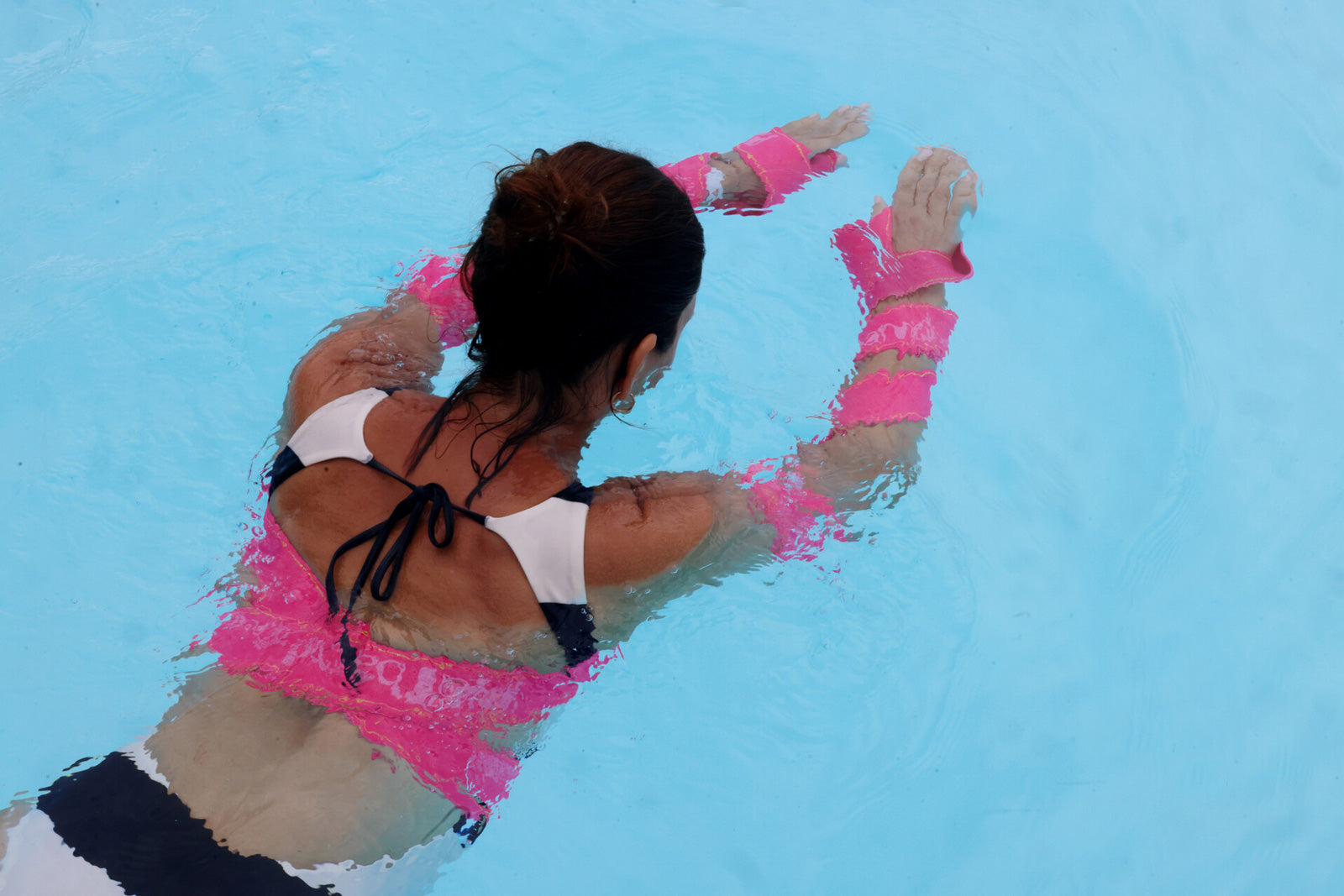
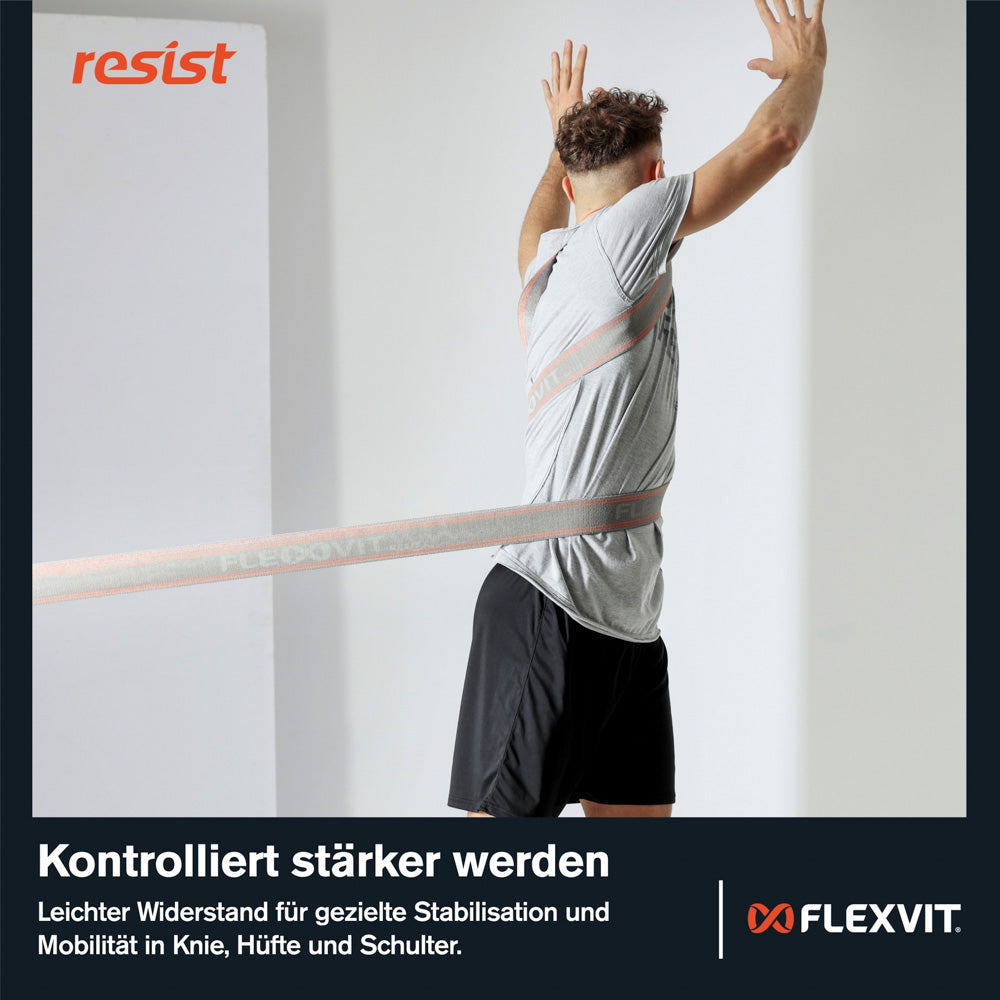
Secure the FLEXVIT Resist safely to a suitable, stable pool ladder or steps. The band is attached to the body according to the intended setup. Then you swim away from the anchor point against the increasing band resistance.
This allows you to continue working in one position, even if the pool is only a few meters long.
The further you move away from the anchor, the greater the band resistance. This allows you to:
- swim continuously against resistance,
- maintain your position in the water,
- complete short strength-oriented intervals,
- work on body tension and propulsion,
- and even use a small pool for targeted training.
Make sure that:
- the attachment point is stable and suitable for the band,
- no sharp edges damage the band,
- the area behind you remains clear,
- other swimmers keep a sufficient distance,
- you do not work against maximum band stretch,
- and you check the band before each session.
In public swimming pools or hotel facilities, you should also clarify beforehand whether attaching and using training equipment is allowed.
We will add the corresponding application video here.
This turns even the smallest vacation pool into a training lane – without constant turning after three arm strokes.
Conclusion: Shoulder health comes from controlled movement
A swimmer's shoulder must be mobile, strong, and resilient at the same time.
This is not achieved by fundamentally inhibiting individual muscles or permanently pulling the shoulder blade into a supposedly perfect position. The key is that the upper arm, shoulder blade, rib cage, and core work together in a coordinated manner.
Functional training with FLEXVIT bands allows you to specifically train this collaboration:
- control external rotation,
- move and stabilize shoulder blades,
- engage the serratus anterior,
- perceive side differences,
- stabilize the core against pulling forces,
- and gradually prepare for overhead movements.
Start with a resistance you can control. First develop control, then gradually increase range of motion, load, and dynamics.
This way, compensatory training does not become another collection of arbitrary shoulder exercises. It becomes a targeted component of your swim training.
And if training on land eventually becomes too dry for you, simply take your FLEXVIT Resist into the water.
Movement is life. Are you ready?